
Electrical & battery
Car Battery Dies Overnight: Causes & Repair Cost
A parasitic draw above 50 mA is the usual culprit. Step-by-step measurement, cost per likely cause, and how to tell a draw from a worn-out battery.
Short answer
If the battery is flat every morning but the alternator checks out, the usual cause is a parasitic draw above 50 mA after the modules sleep — often a stuck relay, an aftermarket stereo, or a door or trunk latch that never signals closed. Diagnosis costs $80–$200; the fix is often less.
The short version
A new battery runs $65–150 depending on size and type, a shop parasitic-drain diagnosis $25–65, and fixing a faulty circuit $40–160.
- 4 symptoms you can check yourself
- 4 diagnosis steps in order
- 2 FAQs answered directly
- Last editorial review: 2026-08-01 · 5 min read
Why this happens
An overnight dead battery has only two real causes: a battery that has reached the end of its life and can no longer hold a charge, or an electrical load (a drain) pulling current while the car sits. A simple multimeter check tells you which within minutes.
Warning signs
- The car cranks slowly or not at all in the morning despite running fine the night before
- Dashboard lights dim before you even try to start
- The battery needs a jump every two or three days
- A rapid clicking sound when turning the key with no engine crank
The practical workshop procedure
Check battery voltage with a multimeter after 8 hours of rest; under 12.4V points to a problem
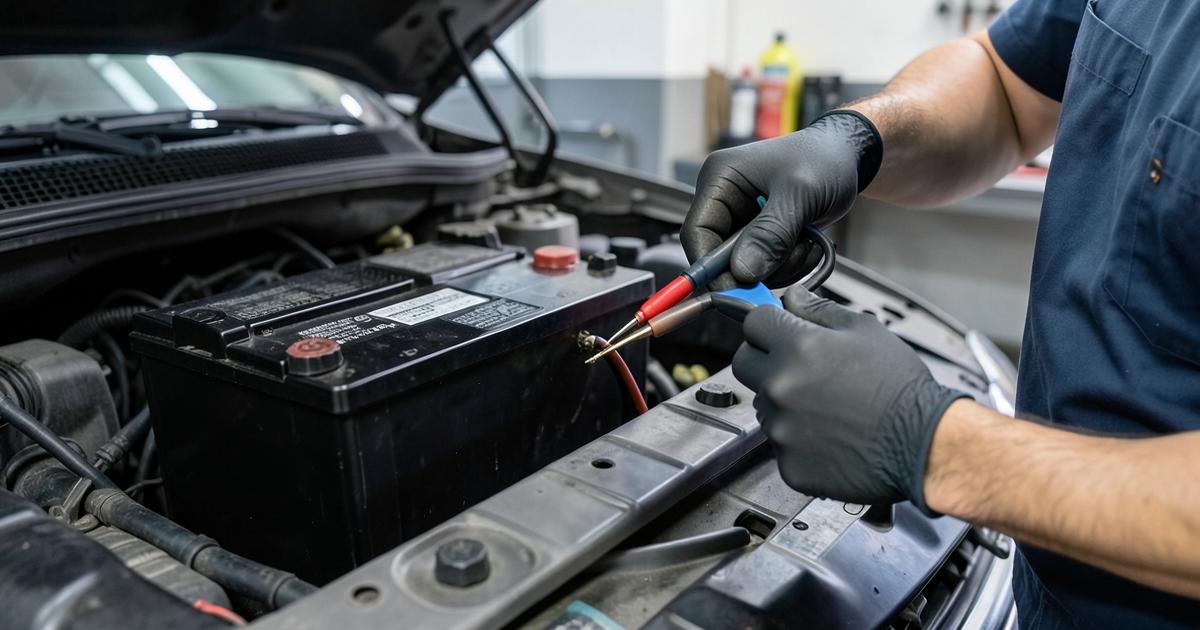
Measure parasitic draw by placing an ammeter in series with the negative terminal
Pull fuses one at a time while watching the reading to isolate the circuit
If voltage drops with no measurable draw, have the battery load-tested for real capacity
Components responsible
- A battery past its typical 3–5 year lifespan that no longer holds charge
- An interior or trunk light left on after the car is locked
- A control module (alarm, daytime lights, radio) drawing constant current while parked
- A loose battery terminal causing slow drain even without an extra load
Cost breakdown
A new battery runs $65–150 depending on size and type, a shop parasitic-drain diagnosis $25–65, and fixing a faulty circuit $40–160.
Figures are a guidance range calculated with a published method — read the methodology.
Run your own estimateQuestions owners ask
How much drain is normal when the car is parked?
Normal draw for radio memory and the alarm is roughly 20–50 milliamps; anything noticeably higher points to a fault worth chasing.
Does fast charging extend a worn battery's life?
No. Repeated fast charging of a battery that has lost capacity only speeds up its failure; replacement is the real fix.
Habits that keep it from returning
Test battery health yearly after year 3, make sure doors and the trunk latch fully, and disconnect the battery if the car sits unused for more than two weeks.
Price table & labor hours
Independent-shop ranges; dealer pricing typically runs 30–60% higher.
| Item | Saudi (SAR) | US (USD) |
|---|---|---|
| Parasitic draw diagnosis | 200 – 500 | 80 – 200 |
| Terminal clean or replace | 50 – 200 | 20 – 80 |
| Stuck relay or switch | 150 – 500 | 60 – 200 |
| Failed battery replacement | 280 – 900 | 120 – 350 |
Estimated labor: 1 – 3 diagnostic hours
Details that lower your bill
Measure it properly: put an ammeter in series with the negative cable, close every door, and wait 30–45 minutes for the modules to sleep. A normal modern car settles at 20–50 mA. If it stays higher, pull fuses one at a time and watch for the drop; the fuse that collapses the reading identifies the circuit.
Rule out the cheap causes first. Green or white corrosion on the terminals raises resistance and mimics weak charging, and a loose ground strap produces the same symptoms. Cleaning and torquing the terminals costs $20–$80 and resolves a meaningful share of cases.
Separate battery from draw by timing. A battery three years or older fails a load test outright and cranks weakly after just two hours parked. A parasitic draw cranks normally during the day and fails completely after 8–10 hours. That time difference is your first real clue.
DriveMet review
A new battery runs $65–150 depending on size and type, a shop parasitic-drain diagnosis $25–65, and fixing a faulty circuit $40–160. Test battery health yearly after year 3, make sure doors and the trunk latch fully, and disconnect the battery if the car sits unused for more than two weeks.
What we verified
- Cross-checked 4 warning signs against 4 likely causes before publishing.
- Reviewed 4 repair steps and confirmed the order a shop would follow.
- Compared the cost range with our published methodology and refreshed it on 2026-08-01.
- Answered 2 questions people actually search for on this topic.
Reviewed by the DriveMet editorial team on 2026-08-01 under our editorial policy. This is an editorial review of the page, not visitor ratings.
Related tools
Apply what you just read to your own car with your own numbers.
Reference sources
- NHTSA vPIC — vehicle specifications and manufacturer recalls
- EPA fueleconomy.gov — reference fuel-economy figures
- SAE J1979 standard for generic (Pxxxx) fault-code definitions
Related articles
Search this site
Ready-made searches that surface the guides, calculators, and cost pages tied to this topic.