
A/C & cooling
How to Flush Radiator Coolant Safely Yourself
Draining the radiator, coolant types (IAT/OAT/HOAT), bleeding air properly, and US pricing.
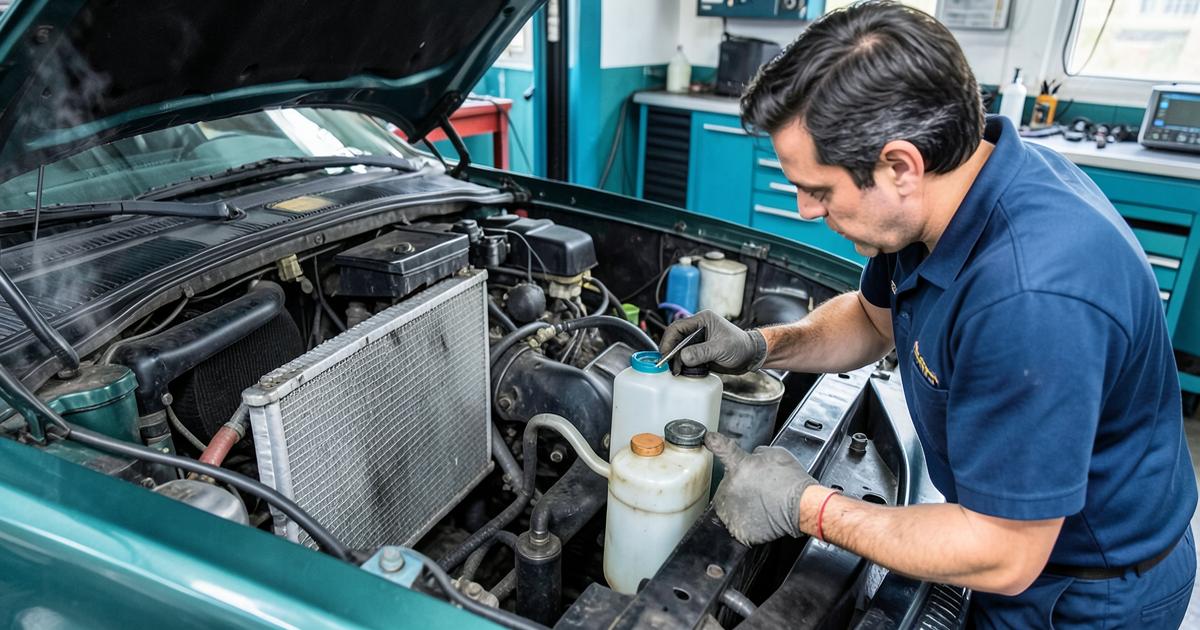
The short version
US pricing: a gallon of pre-mixed coolant is $15–$30 (you need 1.5–2.5 gallons), distilled water $2 a gallon, a bleed funnel $25–$40.
- 5 symptoms you can check yourself
- 5 diagnosis steps in order
- 4 FAQs answered directly
- Last editorial review: 2026-09-10 · 9 min read
Top 3 facts
- Temperature gauge sitting higher than normal, especially in traffic.
- Corrosion inhibitors depleted after several years.
- Work only with a fully cold engine — opening a hot pressurised system causes severe burns.
- No. Colour is not the standard — the chemistry is (IAT, OAT, HOAT). Mixing technologies creates gel that clogs the radiator and heater core, costing far more to fix than the right coolant.
Cost table
US pricing: a gallon of pre-mixed coolant is $15–$30 (you need 1.5–2.5 gallons), distilled water $2 a gallon, a bleed funnel $25–$40. A DIY flush costs $40–$90. A shop charges $120–$220 and a dealer $180–$350. For perspective: a new radiator is $350–$800, a water pump $400–$900, a head gasket $1,800–$3,500 — clean coolant is the cheapest insurance on the car.
Figures are a guidance range calculated with a published method — read the methodology.
Run your own estimateWider context
Coolant does more than cool; it carries corrosion inhibitors that protect the radiator, water pump and cylinder head. When those additives are exhausted (after 3–5 years or 50,000–100,000 miles), internal corrosion starts silently. Flushing is a doable home job, but two steps cannot be skipped: the correct coolant type, and fully bleeding the air.
Early indicators
Sources of failure
- Corrosion inhibitors depleted after several years.
- Tap water leaving scale and mineral deposits.
- Mixing coolant types, producing gel that blocks passages.
- A weak radiator cap failing to hold pressure so coolant boils early.
- A head gasket or oil cooler letting combustion gases into the system.
Steps you should not skip
Work only with a fully cold engine — opening a hot pressurised system causes severe burns.
Place a pan, open the radiator drain cock or pull the lower hose, drain completely, then close it.
Fill with distilled water, run the engine with the heat on full for 10 minutes, shut off, let it cool, and drain again — repeat until it runs clear.
Refill with the correct type: concentrate mixed 50/50 with distilled water, or a pre-mix (traditional green/orange IAT, OAT, or HOAT per your vehicle).
Bleed the air: run the engine with the cap off and heat on maximum until the thermostat opens, squeezing hoses gently, or use a $25–$40 spill-free funnel.
Most asked
Can I use any colour of coolant?
No. Colour is not the standard — the chemistry is (IAT, OAT, HOAT). Mixing technologies creates gel that clogs the radiator and heater core, costing far more to fix than the right coolant.
Cabin heat is weak after the flush — why?
Trapped air, in about 90% of cases. Re-bleed with a spill-free funnel and the front of the car slightly raised so the fill neck is the highest point in the system.
Should I use tap water?
No. Minerals and chlorine accelerate corrosion and leave scale in the passages. Two dollars of distilled water protects a system worth hundreds.
Where should the reservoir level sit?
Between MIN and MAX with the engine cold. If you must top up every couple of weeks there is an external or internal leak — pressure-test it before it becomes an overheat.
Yearly prevention plan
Change coolant on the manual's schedule (typically 3–5 years), never mix types, use only distilled water, and test the radiator cap every two years.
DriveMet review
US pricing: a gallon of pre-mixed coolant is $15–$30 (you need 1.5–2.5 gallons), distilled water $2 a gallon, a bleed funnel $25–$40. Change coolant on the manual's schedule (typically 3–5 years), never mix types, use only distilled water, and test the radiator cap every two years.
What we verified
- Cross-checked 5 warning signs against 5 likely causes before publishing.
- Reviewed 5 repair steps and confirmed the order a shop would follow.
- Compared the cost range with our published methodology and refreshed it on 2026-09-10.
- Answered 4 questions people actually search for on this topic.
Reviewed by the DriveMet editorial team on 2026-09-10 under our editorial policy. This is an editorial review of the page, not visitor ratings.
Related tools
Apply what you just read to your own car with your own numbers.
Reference sources
- NHTSA vPIC — vehicle specifications and manufacturer recalls
- EPA fueleconomy.gov — reference fuel-economy figures
- SAE J1979 standard for generic (Pxxxx) fault-code definitions
Related articles
Search this site
Ready-made searches that surface the guides, calculators, and cost pages tied to this topic.