
Electrical & battery
The 12V Auxiliary Battery in EVs: Why the Car Won't Start Even With a Full Main Battery
The role of the small 12V auxiliary battery in EVs, and why a car may refuse to start despite a fully charged main pack.
The short version
A replacement EV 12V battery: $55-135 per unit, often cheaper than conventional car batteries.
- 5 symptoms you can check yourself
- 5 diagnosis steps in order
- 4 FAQs answered directly
- Last editorial review: 2026-08-31 · 7 min read
The problem in brief
One of the most confusing things for new EV owners is discovering their car won't power on even though the main battery gauge shows 90% or more. The reason is that every EV carries a small conventional 12V battery, entirely separate from the high-voltage main pack, tasked with running basic electronics like locks, screens, and the computer that wakes up the main system on startup. If this small battery weakens, the car may refuse to 'wake up' at all, regardless of the main pack's state.
Root technical cause
- Natural 12V battery lifespan (3-5 years) expiring like any conventional lead-acid battery
- Continuous drain because the system didn't enter sleep mode properly after the car was shut off
- Connected apps or services (like location tracking) keeping the system awake and constantly draining the small battery
- A fault in the DC-DC converter responsible for charging the 12V battery from the main pack
- Leaving the car parked for a long period (weeks) without ever connecting it to charge
Real-world symptoms
- The car doesn't respond at all to the power button even though the main battery screen shows a high percentage
- Dim interior lights or slow-responding door locks before a complete failure occurs
- Sporadic error messages on the central screen about 'low system voltage' or similar
- The car's mobile app not responding when trying to lock or unlock remotely
- Needing to connect a jump-start cable from an external 12V battery to reboot the system
How it is repaired correctly
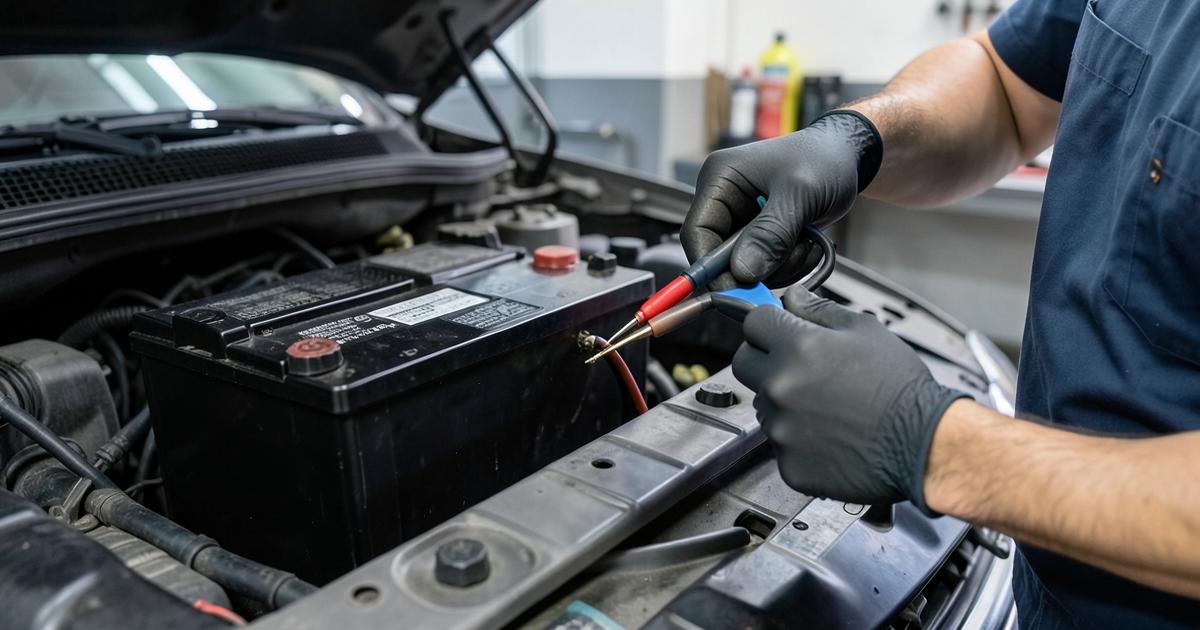
- First confirm the fault is in the 12V battery, not the main pack, by measuring terminal voltage with a voltmeter (should read above 12.4V)
- If voltage is low, use jump-start cables from an external 12V battery or another car to wake the system temporarily
- After starting, leave it connected to the main charger for a few hours so the DC-DC converter automatically recharges the 12V battery
- Have the 12V battery's health checked at the dealer if the failure recurs more than once within a few months
- Request a DC-DC converter check if the battery is confirmed new yet drains repeatedly fast
Reducing the chance of recurrence
Don't leave the EV parked completely without charging for more than two weeks if possible, reduce constant tracking apps that unnecessarily keep the system awake, and request a 12V battery check at every annual service even if the car seems to work normally.
What to expect to pay
A replacement EV 12V battery: $55-135 per unit, often cheaper than conventional car batteries. Installation labor: $15-40. DC-DC converter inspection at the dealer: $40-95, and a full replacement if it fails ranges $400-1,200 depending on model.
Figures are a guidance range calculated with a published method — read the methodology.
Run your own estimateQ&A
Why does an EV even need a conventional 12V battery?
Because the high-voltage main pack (400-800V) is far too dangerous to interface directly with small systems, a low-voltage 12V battery acts as a safe intermediary powering essential electronics and the wake-up computer, much like in conventional cars.
Does a weak 12V battery affect the main battery's lifespan?
Usually no direct effect since they're electrically separate systems, but if the DC-DC converter linking them fails, it can indirectly affect the car's overall charging efficiency.
Can you jump-start an EV like a conventional car?
Yes, but only the auxiliary 12V battery, not the main pack, and manufacturer instructions should be followed precisely since connection points can differ from conventional cars.
How often should the 12V battery in an EV be checked?
It's recommended to check it at least annually during routine service, especially after its third year, since it tends to fail suddenly rather than gradually like conventional car batteries.
DriveMet review
A replacement EV 12V battery: $55-135 per unit, often cheaper than conventional car batteries. Don't leave the EV parked completely without charging for more than two weeks if possible, reduce constant tracking apps that unnecessarily keep the system awake, and request a 12V battery check at every annual service even if the car seems to work normally.
What we verified
- Cross-checked 5 warning signs against 5 likely causes before publishing.
- Reviewed 5 repair steps and confirmed the order a shop would follow.
- Compared the cost range with our published methodology and refreshed it on 2026-08-31.
- Answered 4 questions people actually search for on this topic.
Reviewed by the DriveMet editorial team on 2026-08-31 under our editorial policy. This is an editorial review of the page, not visitor ratings.
Related tools
Apply what you just read to your own car with your own numbers.
Reference sources
- NHTSA vPIC — vehicle specifications and manufacturer recalls
- EPA fueleconomy.gov — reference fuel-economy figures
- SAE J1979 standard for generic (Pxxxx) fault-code definitions
Related articles
Search this site
Ready-made searches that surface the guides, calculators, and cost pages tied to this topic.