
Electrical & battery
Alternator or Battery? A Two-Minute Test That Picks the Culprit Before You Buy the Wrong Part
Dies while driving or just won't crank in the morning? The symptom split identifies the part, and a voltage reading settles it.
The short version
New battery: $70-190 depending on capacity and warranty.
- 5 symptoms you can check yourself
- 5 diagnosis steps in order
- 4 FAQs answered directly
- Last editorial review: 2026-08-29 · 7 min read
Start here
- Battery signs: weak morning crank, dim lights at startup, age past 3-4 years
- Battery: plate sulfation after 3-5 years, or repeated deep discharge
- Check terminals first: clean corrosion and tighten clamps — a potentially free fix
- Yes if the alternator is healthy; 30 minutes of driving restores a usable charge. If it dies again tomorrow, either the battery is finished or the alternator isn't charging.
What you notice while driving
The technical picture, simplified
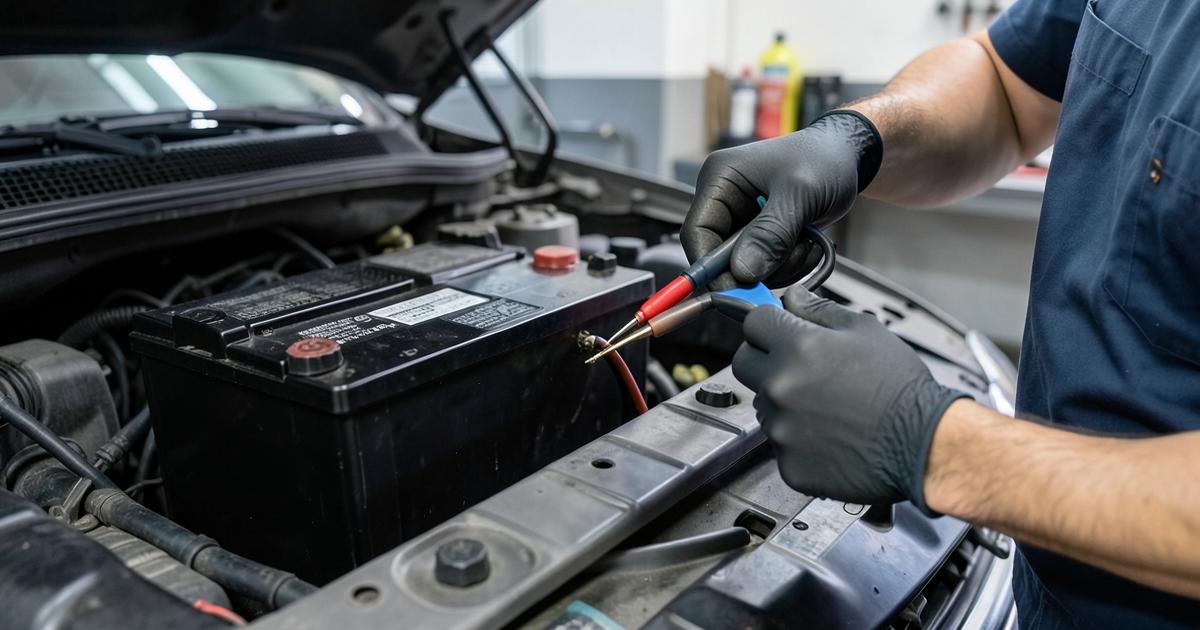
Half the batteries replaced in shops were actually fine — the alternator stopped charging and the battery died as the victim. The split is simple: a weak battery means hard morning cranking with normal behavior the rest of the day; a bad alternator means the car jump-starts then dies while driving because it's living on the battery alone. A $10 multimeter (or a free test at any parts store) settles it: 12.4-12.7V engine off, 13.8-14.4V engine running. Below that, the alternator isn't charging.
Ranked list of possibilities
- Battery: plate sulfation after 3-5 years, or repeated deep discharge
- Alternator: failed voltage regulator, diodes, or brushes
- A worn belt slipping so the alternator under-spins
- Corroded terminals or a loose ground cable mimicking both failures
Repair budget
New battery: $70-190 depending on capacity and warranty. Remanufactured alternator: $110-250; dealer-new $250-700. Charging-system test at parts stores: usually free. Golden rule: buy nothing before a voltage reading — the test is free, the wrong part isn't.
Figures are a guidance range calculated with a published method — read the methodology.
Run your own estimateDiagnostic path
Check terminals first: clean corrosion and tighten clamps — a potentially free fix
Measure battery voltage engine-off: below 12.2V means flat or weak
Start the engine and measure at the terminals: 13.8-14.4V = healthy; under 13V or over 15V = alternator/regulator trouble
Turn on lights and A/C, then re-measure: a big sag under load confirms weak charging
If a dead alternator killed the battery, test the charging system before fitting the new battery — or the new one dies in weeks
Proactive maintenance
Clean terminals every 6 months, inspect the belt at every oil change, and check voltage yearly past year two — five minutes that prevent a roadside stop.
Frequent enquiries
The car jump-started — will driving recharge the battery?
Yes if the alternator is healthy; 30 minutes of driving restores a usable charge. If it dies again tomorrow, either the battery is finished or the alternator isn't charging.
Can I drive with a dead alternator?
Only until the battery drains: 30-60 minutes in daylight, far less at night with lights. Kill all loads and head straight to a shop.
Why did my new battery die after a month?
The usual causes: an alternator not charging or a parasitic drain emptying it overnight. A new battery doesn't fix a system fault.
How long do batteries last in hot climates?
Heat is harder on batteries than cold: 2.5-4 years in the Gulf versus 4-6 in moderate climates.
DriveMet review
New battery: $70-190 depending on capacity and warranty. Clean terminals every 6 months, inspect the belt at every oil change, and check voltage yearly past year two — five minutes that prevent a roadside stop.
What we verified
- Cross-checked 5 warning signs against 4 likely causes before publishing.
- Reviewed 5 repair steps and confirmed the order a shop would follow.
- Compared the cost range with our published methodology and refreshed it on 2026-08-29.
- Answered 4 questions people actually search for on this topic.
Reviewed by the DriveMet editorial team on 2026-08-29 under our editorial policy. This is an editorial review of the page, not visitor ratings.
Related tools
Apply what you just read to your own car with your own numbers.
Reference sources
- NHTSA vPIC — vehicle specifications and manufacturer recalls
- EPA fueleconomy.gov — reference fuel-economy figures
- SAE J1979 standard for generic (Pxxxx) fault-code definitions
Related articles
Search this site
Ready-made searches that surface the guides, calculators, and cost pages tied to this topic.